
You’ve probably seen the pitch.
AI-powered traffic.
Automated clicks.
Hands-free digital growth.
And now you’re researching ClickAgent AI because you’re curious — but cautious.
You want leverage.
You want automation.
But you don’t want another overhyped software tool that promises scale and delivers complexity.
If that sounds familiar, you’re in the right place.
Let’s break this down clearly and strategically.
Understanding the AVATAR: Who Is Searching for ClickAgent AI?
Search intent: informational with light commercial investigation.
You are likely:
- An affiliate marketer or online entrepreneur
- Running paid ads or organic traffic campaigns
- Exploring AI automation tools
- Looking for scalable systems
Emotional State:
- Optimistic but skeptical
- Tired of manual traffic generation
- Curious about automation leverage
- Concerned about ROI
Awareness Level:
You understand digital marketing fundamentals.
You’re now looking for efficiency multipliers.
Not just tactics systems.
What Is ClickAgent AI?
ClickAgent AI appears positioned as an AI-driven marketing automation tool designed to:
- Generate website traffic
- Automate click acquisition
- Optimize campaigns
- Support affiliate or digital offers
At its core, tools like ClickAgent AI promise to reduce manual workload by using artificial intelligence to streamline traffic acquisition.
However, understanding how this works and where the limits lie is crucial.
The Real Problem ClickAgent AI Attempts to Solve
Traffic generation is one of the hardest components of online business.
Manual methods include:
- Content marketing
- SEO optimization
- Paid advertising
- Social media engagement
Each requires:
- Time
- Budget
- Testing
Automation promises speed.
But automation without strategy creates noise.
The Automation Illusion: What AI Can and Cannot Do
AI marketing tools can:
- Analyze patterns
- Optimize ad placements
- Test variations faster
- Automate repetitive tasks
AI cannot:
- Replace offer-market fit
- Fix weak messaging
- Guarantee conversions
Technology enhances leverage.
It does not create demand.
Where ClickAgent AI Potentially Adds Value
1. Speed of Testing
AI tools can run:
- Split tests
- Click optimization sequences
- Traffic routing experiments
Faster iteration means faster data.
2. Reduced Manual Labor
Instead of:
- Monitoring dashboards hourly
- Adjusting campaigns manually
Automation may streamline workflow.
Efficiency matters for scaling.
3. Data Aggregation
AI systems often analyze:
- Click behavior
- Engagement patterns
- Geographic performance
This can improve campaign refinement.
Hidden Risks of Over-Reliance
Traffic Quality Concerns
Not all clicks equal value.
Low-intent traffic can:
- Inflate metrics
- Reduce conversion rate
- Waste ad spend
Quality > volume.
Platform Compliance
Automated traffic tools must comply with:
- Advertising platform rules
- Affiliate network policies
Violations can result in account suspension.
Due diligence protects longevity.
False Sense of Security
Automation may create:
“I can set it and forget it.”
Sustainable growth requires monitoring and optimization.
AI supports, it does not replace strategy.
Cost of Inaction: Why Ignoring Automation May Limit Growth
If competitors use AI tools effectively, they may:
- Test faster
- Scale quicker
- Reduce operational costs
Manual-only workflows may struggle to compete long term.
Efficiency compounds.
How to Evaluate ClickAgent AI Strategically
Before adopting any AI marketing software, ask:
1. What Specific Problem Does It Solve?
Is it traffic volume, optimization, or conversion refinement?
2. What Is the Data Source?
Where does the traffic originate?
3. What Is the Cost Structure?
Subscription vs usage-based?
4. What Metrics Matter?
Clicks alone don’t equal profit.
Evaluate:
- Cost per acquisition
- Conversion rate
- Return on ad spend
Metrics determine value.
Case-Style Scenario
Entrepreneur A:
- Relies purely on organic content
- Sees slow growth
Entrepreneur B:
- Uses AI automation
- Tests 20 variations weekly
- Identifies winning angles faster
Speed improves opportunity detection.
But both still need strong offers.
Psychological Drivers Behind AI Adoption
ClickAgent AI appeals to:
Freedom: Less manual work.
Security: Scalable systems.
Status: Being ahead technologically.
Efficiency: Faster iteration cycles.
AI feels like leverage.
Leverage feels empowering.
But empowerment requires understanding.
Common Objections
“Is ClickAgent AI just another traffic bot?”
Legitimate AI tools use data-driven optimization.
However, any software promising artificial traffic inflation without user intent should be approached cautiously.
“Will it replace my need to learn marketing?”
No.
Core skills remain essential:
- Copywriting
- Audience targeting
- Funnel optimization
AI amplifies competence.
“Is automation risky?”
Risk depends on implementation.
Test small.
Monitor metrics.
Scale gradually.
Disciplined testing reduces exposure.
Integrating ClickAgent AI Into a Growth Strategy
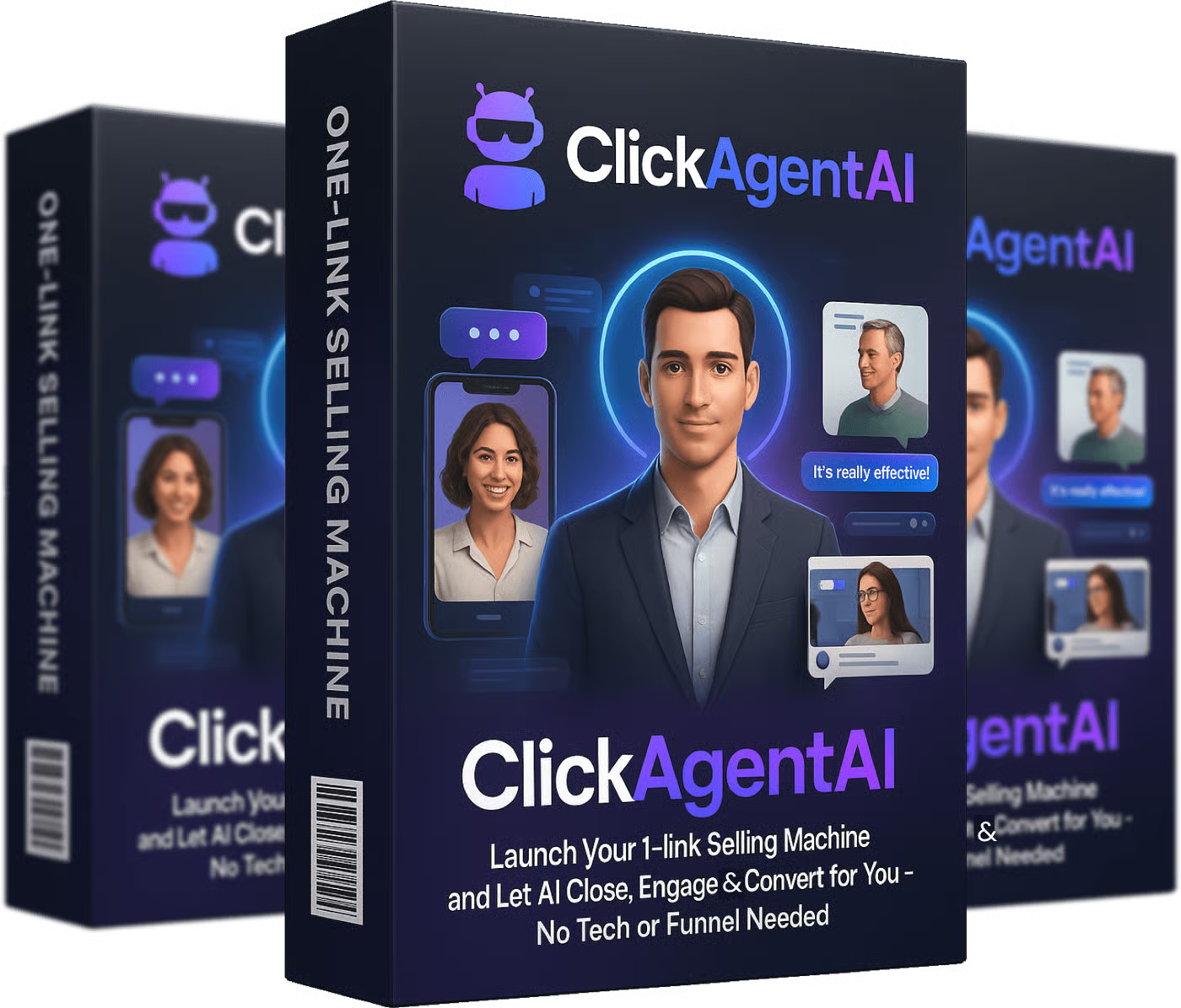
If implemented wisely:
- Define clear goals
- Test one campaign
- Track conversion metrics
- Compare against manual baseline
- Optimize gradually
Treat AI as a performance enhancer, not a magic solution.
Long-Term Positioning: AI as Infrastructure
The future of marketing includes:
- Automation
- Predictive analytics
- Adaptive optimization
Ignoring AI may limit competitiveness.
Blindly adopting AI may create dependency.
Balanced integration wins.
Is ClickAgent AI Right for You?
It may align if:
- You already understand marketing basics
- You want faster testing cycles
- You track metrics carefully
- You scale offers consistently
It may not fit if:
- You expect instant profit
- You lack funnel structure
- You don’t monitor analytics
AI rewards structured operators.
Strategy First, Automation Second

ClickAgent AI represents a broader shift:
From manual grind
To intelligent systems
But systems require direction.
If you’re considering ClickAgent AI, begin by clarifying:
- Your current conversion rate
- Your traffic costs
- Your growth bottleneck
Then test automation strategically.
Growth is not about chasing tools.
It’s about building leverage responsibly.
If you’d like, review your current traffic workflow and identify which steps consume the most time; that’s where AI may provide a measurable impact.
Frequently Asked Questions (FAQ)
1. What is ClickAgent AI designed to do?
ClickAgent AI is positioned as a marketing automation tool that aims to streamline traffic generation and campaign optimization using artificial intelligence. It typically focuses on improving efficiency, testing speed, and data-driven decision-making within digital marketing funnels.
2. Does ClickAgent AI guarantee more sales?
No. While AI tools can help optimize traffic flow and campaign performance, they cannot guarantee conversions. Sales depend on factors such as offer quality, audience targeting, pricing strategy, and funnel optimization.
3. Is ClickAgent AI suitable for beginners?
It may be better suited for users who already understand basic marketing principles. Without knowledge of conversion metrics, traffic quality, and compliance standards, beginners may struggle to evaluate whether the tool is delivering real ROI.
4. What risks should I consider before using ClickAgent AI?
Key considerations include:
- Traffic source quality
- Platform compliance policies
- Subscription cost vs return
- Data accuracy
Testing with a small budget and tracking performance metrics can reduce risk.
5. How should ClickAgent AI fit into a broader marketing strategy?
ClickAgent AI should support, not replace core strategy. It can be integrated into an existing funnel to accelerate testing, automate repetitive tasks, and optimize campaigns, but foundational elements like messaging and offer-market fit remain essential.
6. How do I measure whether ClickAgent AI is worth the investment?
Track objective metrics such as:
- Cost per acquisition (CPA)
- Conversion rate
- Return on ad spend (ROAS)
- Customer lifetime value (LTV)
Compare performance before and after implementation to determine measurable improvement.
Recommended Resources
To better understand the performance impact.
For official guidance on advertising compliance and ethical traffic generation, explore the Federal Trade Commission (FTC) Advertising & Marketing Guidelines, which outline best practices for digital marketers.